

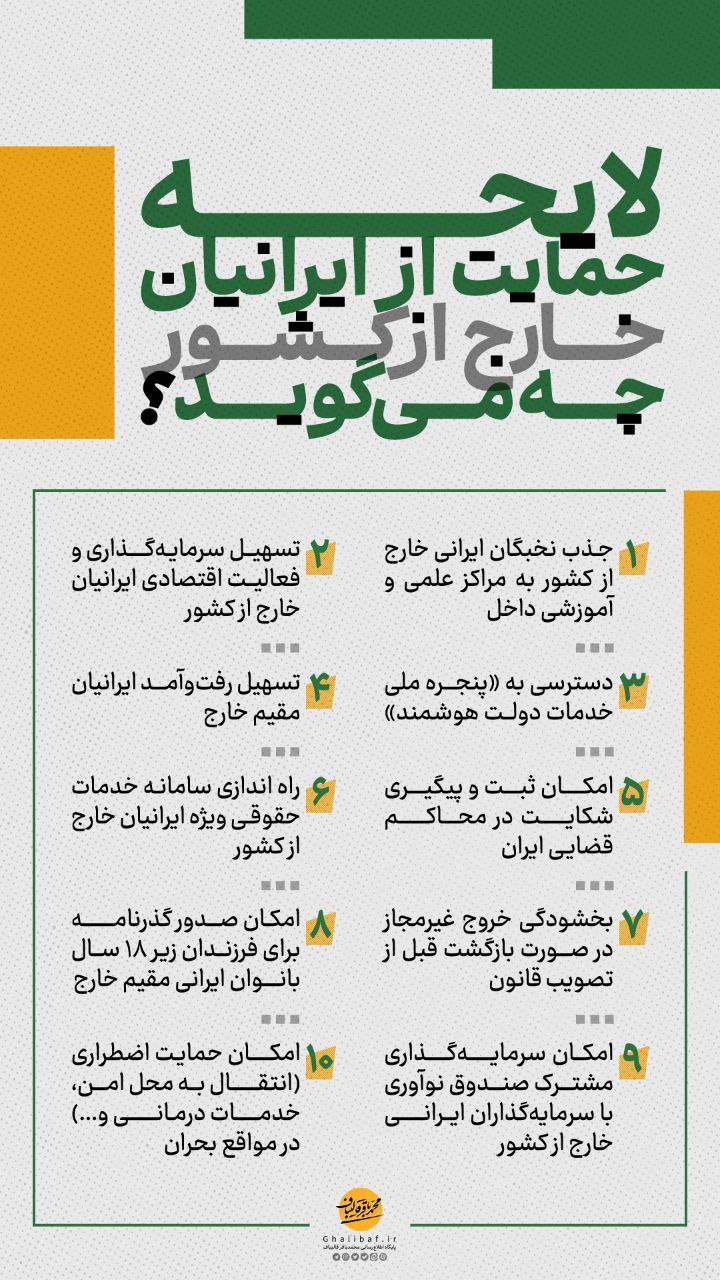
The Bill to Support Iranians Abroad: A Step Toward Leveraging Transnational National Capacities
In line with strengthening national governance and engaging the vast capacities of Iranians living abroad, the Islamic Republic of Iran has drafted a bill titled “Support for Iranians Abroad.” This bill aims to address a variety of scientific, economic, legal, and identity-related objectives.
According to the provisions of this bill, the central focus is on facilitating the Iranian government’s interaction with millions of expatriates and harnessing their talents and resources for national development. From the perspective of think tanks and policy research institutions, this initiative can be regarded as an example of effective public diplomacy and the expansion of international social capital.
Ten Key Provisions of the Bill to Support Iranians Abroad:
-
Attracting Iranian experts and scholars abroad to collaborate with domestic academic and scientific institutions
-
Facilitating investment and economic engagement for Iranians abroad
-
Providing access to the National Smart Government Services Portal for administrative and identity-related matters
-
Reducing travel and residency barriers for Iranian expatriates
-
Enabling online registration and legal follow-ups in Iranian courts without physical presence
-
Establishing a dedicated legal services platform for Iranians abroad
-
Granting amnesty for unauthorized exits if return occurs after the law is passed
-
Issuing passports for children under 18 born to Iranian women living abroad
-
Allowing joint investment in the Innovation and Technology Fund with overseas Iranian investors
-
Providing emergency support in times of crisis (e.g., evacuation, medical services, etc.)
Policy Significance from a Governance Perspective
From the standpoint of governance-focused think tanks, this bill aims to rebuild identity ties between the Iranian diaspora and their homeland. It holds the potential to promote digital public services, restore public trust, and encourage elite return and diaspora investment.
Its successful implementation, however, will depend on well-designed administrative, technological, and legal infrastructures, inter-agency coordination, and the incorporation of empirical research into the real needs of Iranians living abroad.